

There's an uncomfortable open secret in machine learning: a large share of models that work beautifully in a data scientist's notebook never make it into production. The model isn't the problem — everything around it is. The discipline that closes that gap is MLOps.
The notebook-to-production chasm
A model in a notebook runs once, on a clean dataset, on one machine, evaluated by the person who built it. A model in production must run continuously, on messy real-world data, integrated with live systems, monitored for quality, retrained as the world changes, and rolled back safely when something breaks. The distance between those two states is where most projects die.
Teams that treat the trained model as the finish line are setting themselves up to stall. The trained model is the starting line.
What MLOps actually covers
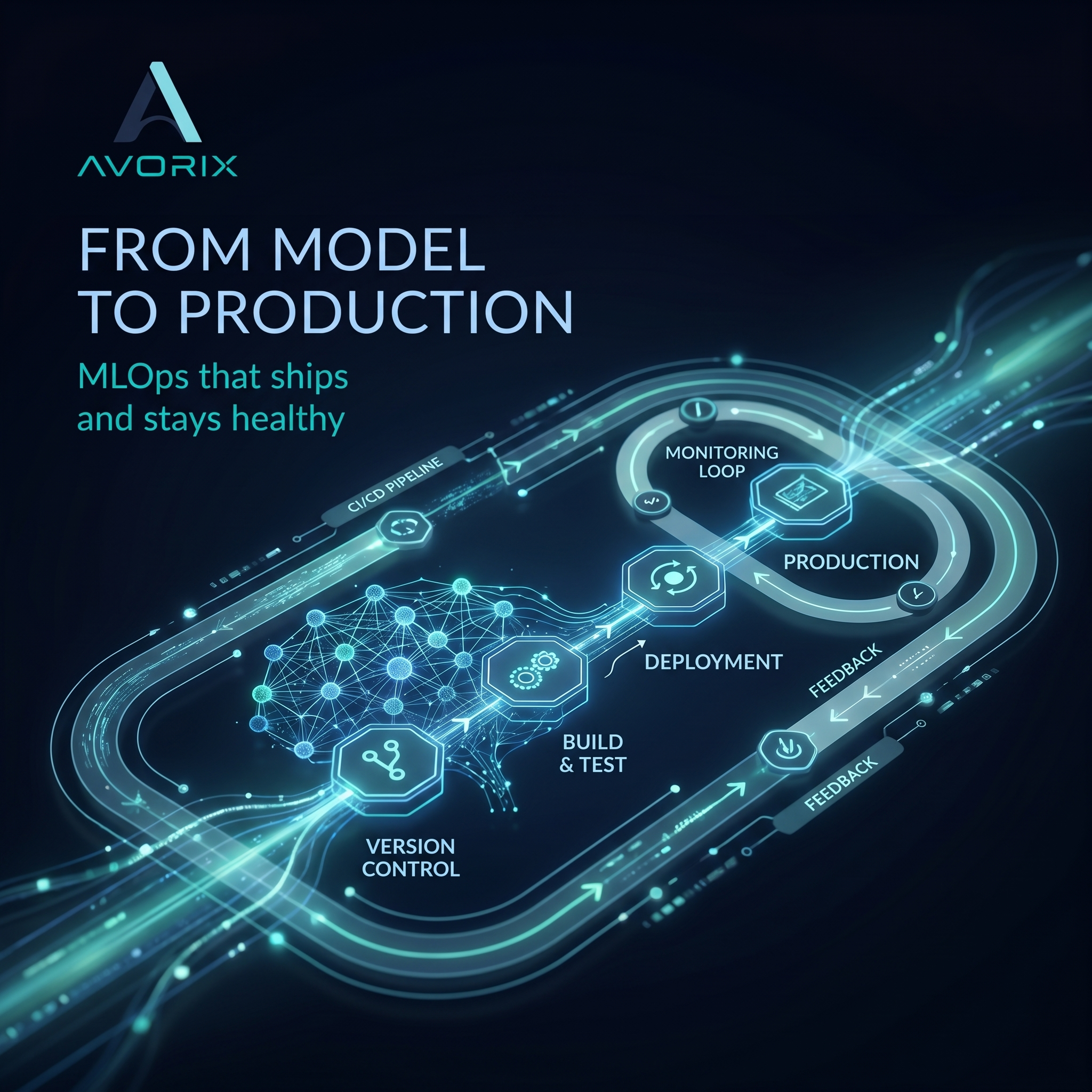
MLOps applies the lessons of DevOps to machine learning. It covers reproducible training pipelines, versioning of both code and data, automated deployment of models behind reliable APIs, monitoring of model quality in production, and automated or streamlined retraining. The goal is to make shipping and maintaining a model as routine and reliable as shipping any other software.
The problem that doesn't exist in normal software: drift
Regular software does the same thing tomorrow as today. A model doesn't — because the world it learned from keeps changing. Customer behavior shifts, new products launch, fraud patterns evolve. This is model drift, and a model that was accurate at launch can quietly degrade into one that's actively wrong. Without monitoring, you won't notice until it's caused damage.
MLOps builds in the monitoring to catch drift and the pipelines to retrain before quality slips — turning a model from a one-time artifact into a living system.
Why this is an engineering problem
Getting a model to production reliably is mostly software and infrastructure work: data pipelines, APIs, deployment, monitoring, rollback. Data scientists are often not staffed or focused to do all of this, which is exactly why so many models stall. Pairing modeling talent with strong engineering — or partnering with a team that does both — is what gets models shipped.
How to ship more of your models
Start by treating production as a first-class goal from day one, not an afterthought. Build the deployment and monitoring path early, even for a simple model, so the pipeline exists before you optimize the model. Define what "healthy in production" means and measure it continuously. Ship small, monitor, improve.
The takeaway
Most ML models don't fail because the model is bad — they fail because nobody built the path to production and the system to keep them healthy. MLOps is that path. It's the difference between an impressive demo and a model that delivers value for years.
Have models stuck in notebooks? Talk to AVORIX.