
When a system goes down at the worst possible moment, there are two kinds of teams: the ones who open a dashboard and find the cause in minutes, and the ones who guess, restart things, and hope. The difference between them is observability. It's one of the least glamorous investments in software — and one of the highest-return.
Monitoring vs observability
Monitoring tells you that something is wrong — a server is down, response times are up. Observability tells you why. Monitoring answers questions you knew to ask in advance; observability lets you ask new questions about your system's behavior without shipping new code to find out. As systems grow more complex — more services, more moving parts — the ability to explore and understand becomes essential, because you can't predict every failure mode in advance.
The three pillars
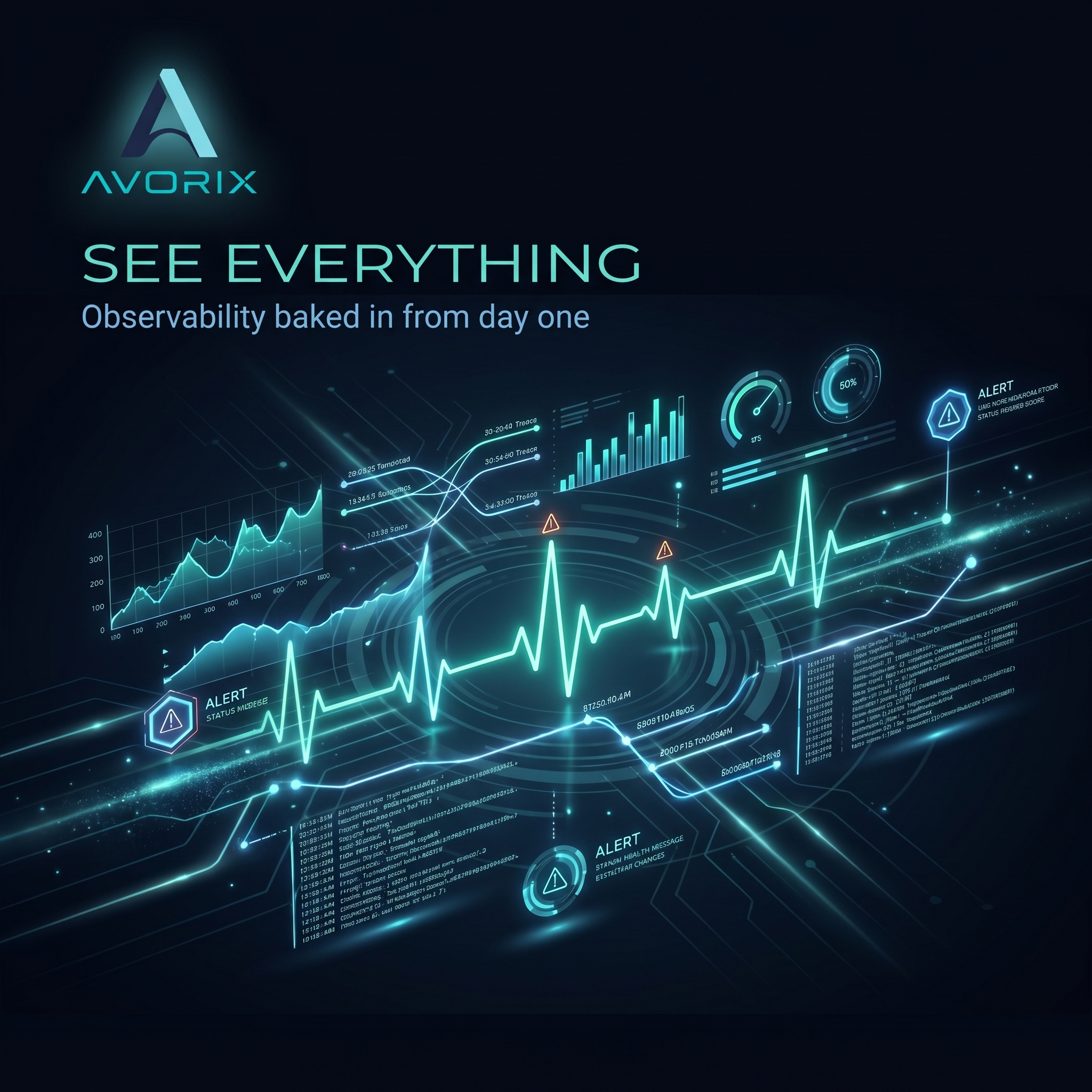
Observability rests on three types of data. Metrics are numbers over time — request rates, error rates, latency, resource use — great for spotting that something changed and for alerting. Logs are detailed records of events, the narrative of what happened. Traces follow a single request as it travels through all your services, showing exactly where time was spent and where it broke. Together they let you move from "something's wrong" to "here's the exact cause" quickly.
Why it pays for itself
The return on observability shows up in the moments that matter most. A well-instrumented system turns a multi-hour, all-hands outage into a quick, targeted fix. It lets you catch problems — a slow memory leak, a creeping error rate — before customers ever notice. And it gives you the data to optimize performance and cost intelligently instead of guessing. The cost of building observability in is small; the cost of not having it during a major incident is enormous.
Alerting that people actually trust
Observability data feeds alerting, and alerting is easy to get wrong. Too many alerts and your team tunes them out — so the one that matters gets missed in the noise. Good alerting pages humans only for genuine, actionable problems and stays quiet otherwise. An alert should mean "a person needs to act now," and the team should trust that it does. Tuning this is an ongoing discipline, not a one-time setup.
Build it in, don't bolt it on
The best time to add observability is while you build, not after an outage teaches you the hard way. Instrument services to emit useful metrics, logs, and traces from the start; it's far easier than retrofitting, and it means you're ready the first time something goes wrong. Like security, observability is cheapest and most effective when it's designed in.
The takeaway
Observability — metrics, logs, and traces, plus trustworthy alerting — is what lets you understand and fix complex systems fast. It turns mystery outages into quick wins and catches problems before users do. You can't fix what you can't see, so make your systems visible.
Want systems you can actually see into? Talk to AVORIX.