
If you've built anything with modern AI — a smart search box, a recommendation engine, a chatbot that answers from your documents — there's a good chance a vector database is doing quiet, essential work behind the scenes. Here's what they are and why they've become foundational, explained without the jargon.
The problem with keyword search
Traditional search matches words. Search "cheap flights" and it looks for those exact words. But it has no idea that "affordable airfare" means the same thing. It matches characters, not meaning. For a lot of modern applications — especially anything involving AI — that's a serious limitation.
Enter embeddings: meaning as numbers
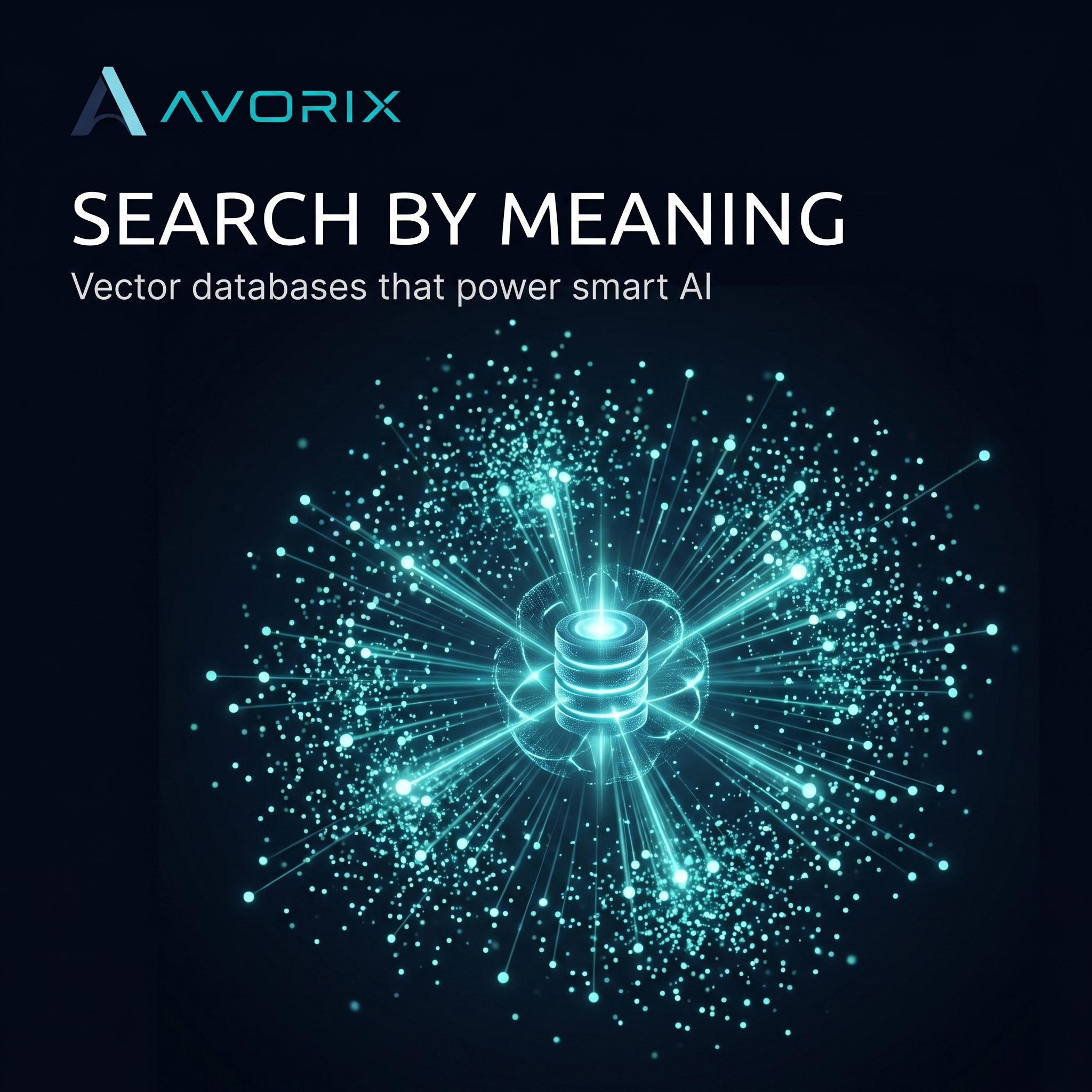
The breakthrough is the embedding: a way of turning text (or images, or audio) into a list of numbers — a vector — that captures its meaning. Two pieces of content with similar meaning end up with similar vectors, close together in a high-dimensional space, even if they share no words. "Affordable airfare" lands right next to "cheap flights."
A vector database is built to store millions of these embeddings and answer one question extremely fast: "what's most similar in meaning to this?" That's called similarity search, and it's the engine behind a surprising amount of modern AI.
What vector databases power
Semantic search: find results by meaning, not keywords — far better for natural-language queries. Recommendations: find items similar to what a user liked. RAG (retrieval-augmented generation): when an AI assistant answers from your documents, a vector database is what finds the relevant passages to feed the model. Deduplication and clustering: group similar content automatically.
If you're building any AI feature that needs to "find the relevant thing," a vector database is likely involved.
What makes them different from a normal database
A traditional database is optimized for exact matches and structured queries. A vector database is optimized for approximate similarity at scale — finding the nearest neighbors among millions of vectors in milliseconds, using specialized indexing. They're not a replacement for your relational database; they sit alongside it, handling the "find by meaning" job that traditional databases do poorly.
How to use one well
The quality of a vector search depends heavily on the embedding model you choose and how you chunk your content. Poorly chunked documents produce poor retrieval, which produces poor AI answers — the classic "garbage in, garbage out." Getting the data pipeline right matters as much as the database itself. This is where many DIY RAG projects quietly underperform.
The takeaway
Vector databases turn meaning into something a computer can search instantly. They're the engine behind semantic search, recommendations, and the RAG systems that let AI answer from your data. If you're building intelligent features, understanding them — and implementing them well — is no longer optional.
Building AI search or a RAG system? Talk to AVORIX.