
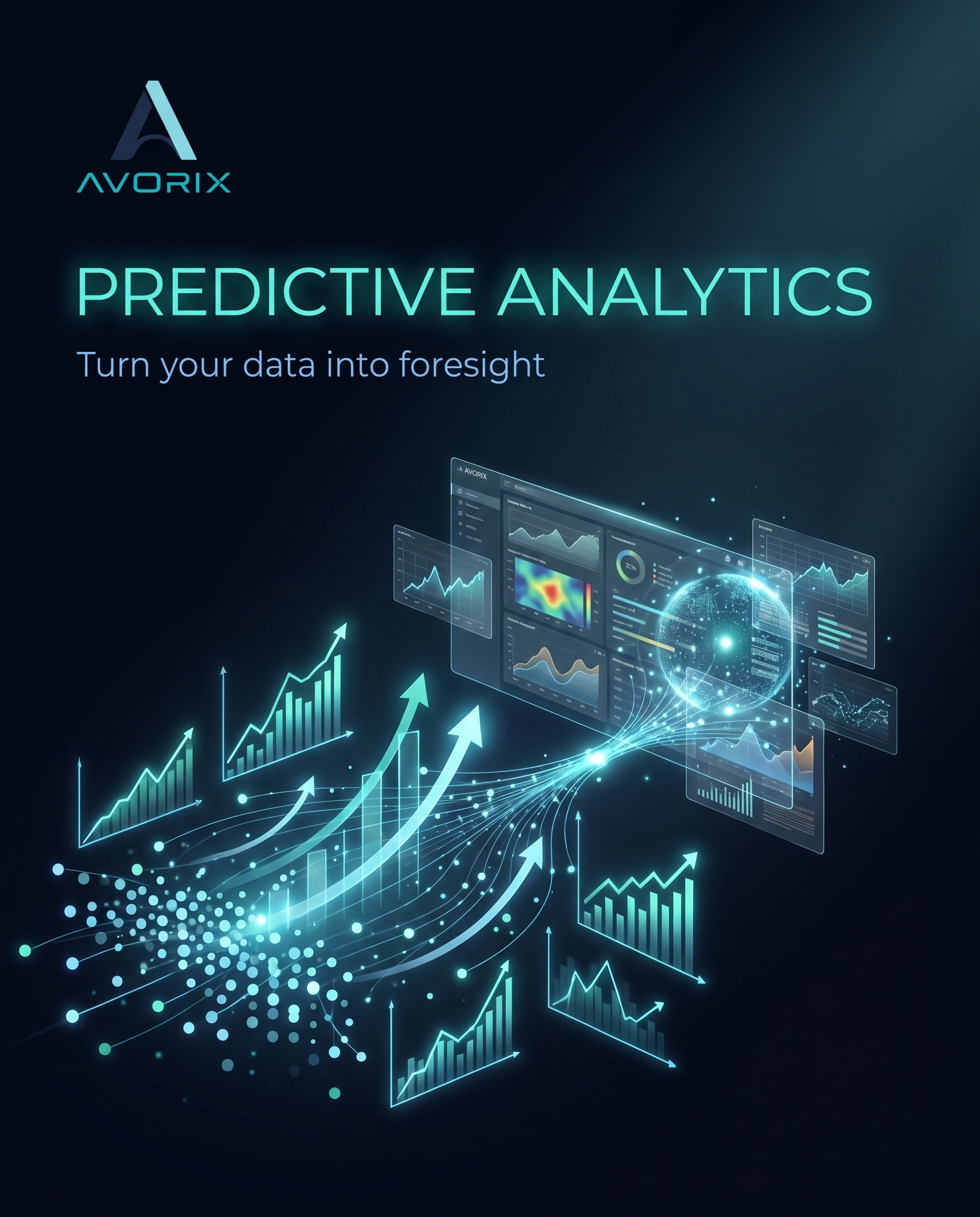
Most businesses sit on a goldmine of historical data and use it only to look backward — reporting what already happened. Predictive analytics flips that: it uses the same data to look forward, forecasting what's likely to happen next so you can act before the moment arrives instead of reacting after it's gone.
What predictive analytics actually is
At its core, predictive analytics finds patterns in historical data and uses them to estimate future outcomes. Given enough examples of what happened before — sales by season, which customers churned, when machines failed — a model learns the relationships and produces forecasts for new situations. It doesn't predict the future with certainty; it shifts the odds in your favor by replacing guesswork with evidence.
Where it delivers the most value
The highest-impact applications share a trait: a decision that's currently made on gut feel but could be made on data. Demand forecasting so you stock and staff correctly. Churn prediction so you intervene with at-risk customers before they leave. Predictive maintenance so you service equipment before it fails. Risk and fraud scoring so you catch problems early. Capacity planning so your infrastructure is ready for load. In each case, foresight turns a costly surprise into a managed decision.
You don't need perfect data — you need enough
A common blocker is the belief that you need pristine, massive datasets before you can start. In reality, many valuable predictions can be made with the data you already have, even if it's imperfect. What matters is that the data is relevant to the outcome you want to predict and that you have enough history to learn from. Starting with a focused question and the data you have beats waiting for a perfect dataset that never arrives.
From prediction to action
A forecast is only valuable if it changes a decision. The most common failure in predictive analytics is producing accurate predictions that nobody acts on — a dashboard people admire and ignore. Design the project around the action from the start: who will use the prediction, in what moment, to make what decision? Deliver the insight where that decision happens, not in a report no one opens.
Getting started without overcommitting
Pick one high-value decision, gather the relevant history, and build a focused model to support it. Measure whether it actually improves the decision against the old way. A contained first project proves value, builds trust, and creates the momentum to expand into other areas — far better than a sprawling "AI initiative" with no clear owner.
The takeaway
Predictive analytics turns the data you already collect into foresight you can act on — forecasting demand, churn, failures, and risk. The winners aren't those with the most data, but those who connect a prediction to a decision and act before the moment passes.
Want to turn your data into foresight? Talk to AVORIX.