
Most companies don't have an AI problem — they have an AI integration problem. The models are impressive in a demo, but turning that demo into something wired into real operations, producing real value, is where the majority of projects stall. Here's how to do it properly.
Start with the problem, not the model
The single biggest mistake in AI adoption is starting with "we should use AI" instead of "here's a costly, repetitive, or slow process we want to fix." AI is a tool, not a strategy. Begin by listing the workflows that eat the most human hours or cause the most errors: support triage, document processing, data entry, forecasting, search. Those are your candidates.
For each candidate, ask three questions: Is there enough data to support it? Is the task well-defined enough to measure success? And what's the cost of being wrong? The best first projects are high-volume, well-defined, and tolerant of an occasional miss with a human in the loop.
The three main ways to integrate AI
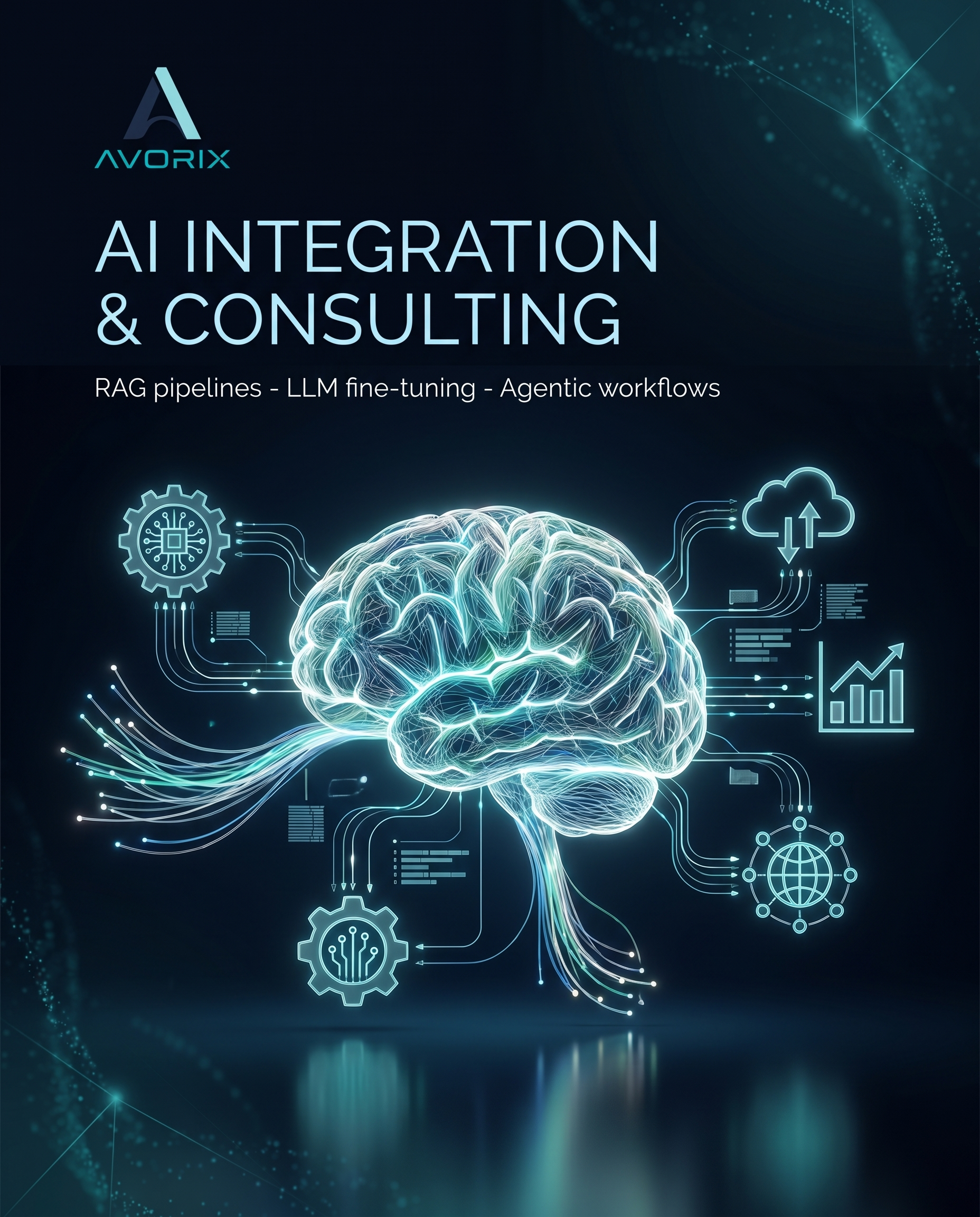
Broadly, business AI integration takes one of three shapes. Retrieval-augmented generation (RAG) connects a language model to your own data so it answers from your knowledge, not the open internet — ideal for support, internal search, and documentation. Workflow automation with agents lets AI take multi-step actions across your tools, not just answer questions. And predictive models turn historical data into forecasts: demand, churn, risk.
Most real deployments combine these. A support assistant might use RAG to find the right answer and an agent to actually open a ticket or issue a refund.
Why integration — not the model — is the hard part
A foundation model is a commodity you can call with an API. The value is created in everything around it: connecting it to your data securely, grounding it so it doesn't hallucinate, adding guardrails, handling edge cases, monitoring quality, and fitting it into the screens your team already uses. This is engineering work, and it's where projects succeed or fail.
Treating AI as "plug-and-play" is the fastest route to a disappointing pilot. Budget for the integration, not just the model.
Measure, then expand
Define success metrics before you build: deflection rate for a support bot, hours saved for a document pipeline, accuracy for a forecast. Run a contained pilot, measure honestly, and only then expand. This protects your budget and builds internal trust — each win makes the next project easier to fund.
Keep humans in the loop early
Early on, keep a human reviewing AI output. This catches errors, builds a feedback dataset that improves the system, and reassures your team. As confidence grows, you can automate more. The goal isn't to remove people — it's to remove the drudgery so people focus on the work that needs them.
The takeaway
Successful AI integration starts with a real problem, picks the right pattern (RAG, agents, or prediction), invests in the integration work, and measures relentlessly. Do that and AI stops being a science project and starts being a line on your P&L.
Want help finding where AI actually pays off in your business? Talk to AVORIX.